
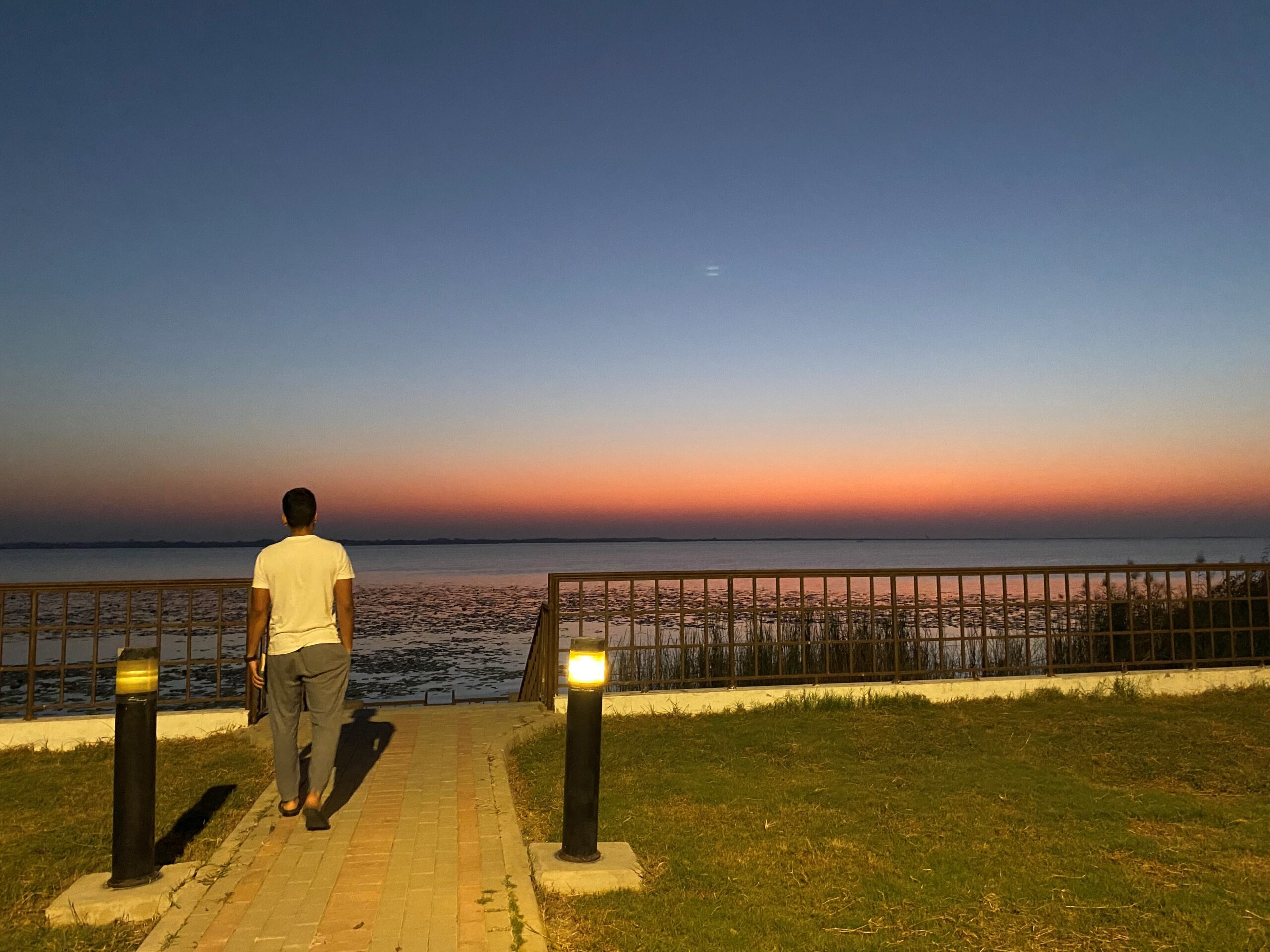
My mother-in-law had been pining for a trip to the lake since the day she had arrived so we finally decided to drive her up there and spend a night by the lakeside this weekend. It had been a while since I and Fatima had visited the lake anyway so I pushed my workout up from the usual afternoon to early morning and planned to set off after the Friday prayers.
I like to keep my travel prep simple. The ritual involves going over three things: book, clothes and dress. The perk of traveling with my wife (apart from her cherishable company, of course) is that she takes care of everything else so I only have to worry about the first – a book that would go with the clear lake and skies, in this case. My bookshelf here is in a bit of a crisis since I’ve been lending out more books lately than I’m buying so it was to be a challenge to pick something uniquely suited to the occasion. But I soon realized I was mistaken when I noticed The Sheldon Book of Verse, an anthology of poems, tucked away in a dusty corner for God-knows-how-many years. I plucked out the paperback and took a moment to appreciate its handiness and vintage aesthetic appeal. Published in 1957, no wonder it was a relic from the past.

As I drove down the M-9, the scenic Kirthar Mountains appeared on the driver’s side. It’s hard to ignore the distinctive mesas (i.e. flat-topped hills) standing solemnly in the barren wilderness. While I saw their distant figures behind the haze of smog every day while commuting back from work, it was a totally different experience to see them up close by the roadside. Ancient vagabonds riveted in space but traveling through time, I thought. For some reason unknown to me, the sight of these mountains in particular, and nature in general, is immensely liberating and awe-inspiring to me, offering a sense of humility and freedom from all that’s trivial. I rolled down my car window to take in the fresh winter afternoon.

Soon the wind turbines were visible on the passenger side. Hashir would be excited to see them but he was already asleep in his grandfather’s lap. As I got off the motorway and headed towards Jhampir, we realized we were snaking through the vast fields of wind turbines on both sides, their blades and towers now too imposing to take in a single glance. It took some five minutes of gentle patting on Hashir’s face to wake him up from the slumber he had drifted into during the past half hour, but the surprised smile that plastered itself on his dazed, still-sleepy face once he saw the giant structures made it worth the effort.

The link road leading to Jhampir had several cattle farms belonging to Palari and Jakro tribes. A shrine (مزار شریف) would pop up every few kilometers reminding me of what M. A. Yusufi wrote about the shrines of sham saints in Sindh in his book, Aab-e-Gum:
ان سے متعلق ہر چیز شریف ہے سواۓ صاحب مزار کے
The road is surprisingly fine compared to what you expect a link road in interior Sindh to be like. But it gets deceptive further ahead as you find suspicious speed breakers in the middle of nowhere that can cause serious damage to your car if you aren’t vigilant. The link road culminates at a bridge over the railway crossing at Jhampir station. We were even able to show Hashir his first train up close while stopping by the same bridge on our way back.

From there on, it’s a narrow 6 km road to the motel. The road is lined on both sides by acacia and sometimes, date-palm trees particularly as you head closer to the lake. Parchoon shops set up in tiny cabins and manned by stout, thick-mustached Sindhis donning traditional Sindhi caps make for an interesting sight. The peculiar, familiar scent associated with the sea for a Karachiite becomes noticeable much before the lake is even visible. Soon we are driving through the non-descript motel gate. The sun is still well above the horizon. We have managed to reach in time.

The sun sets opposite the lake which means you can’t photograph the majestic lake sunsets you might have thought to capture on your way here. This can be a bit disappointing until you realize that it also means the sun would rise right above the lake the next morning. After a cup of tea and dinner, and a lot of sky- and lake-watching and mosquito-fighting in between, I snuggled up in bed with my book hoping to wake up to catch the first ray of sun the next day.

I woke up in the morning twilight an hour before sunrise and headed straight out into the cold in my T-shirt and pajamas, anxious not to miss a single moment of the miracle that is a false dawn. Soon the fishing boats start to appear in distance; fishermen starting their day, rowing and setting up nets. Despite the biting cold none of us was prepared for (except me since my wonderful wife had packed in a hoodie), we gathered on the lawn in anticipation of the sunrise.


The sun came up slowly and majestically from under the lake. Picture and video credits go to my sister-in-law who is a shutterbug and maintains an impressively artistic social media presence. Everybody basked in the warm sun while I and Fatima made breakfast in the rickety motel kitchen. In just a couple hours, the sun was high up in the sky and the lake began to simmer sending us back to our rooms. With the monumental event of the day over and the temperatures rising steadily, there was little else to do at the motel except pack our bags and get going.
While the narrative of the story ends, the reflections, too many to recount here, demand a sequel which I will be writing shortly. Until then, Ciao!


 My return flight was 1000 hrs and the tomb was to open for visitors at 0900 hrs so this is the closest I got to Mevlana. I could see a series of small minarets of Mevlana’s tomb from the courtyard and wondered what life would be like for dervishes in the cells underneath them.